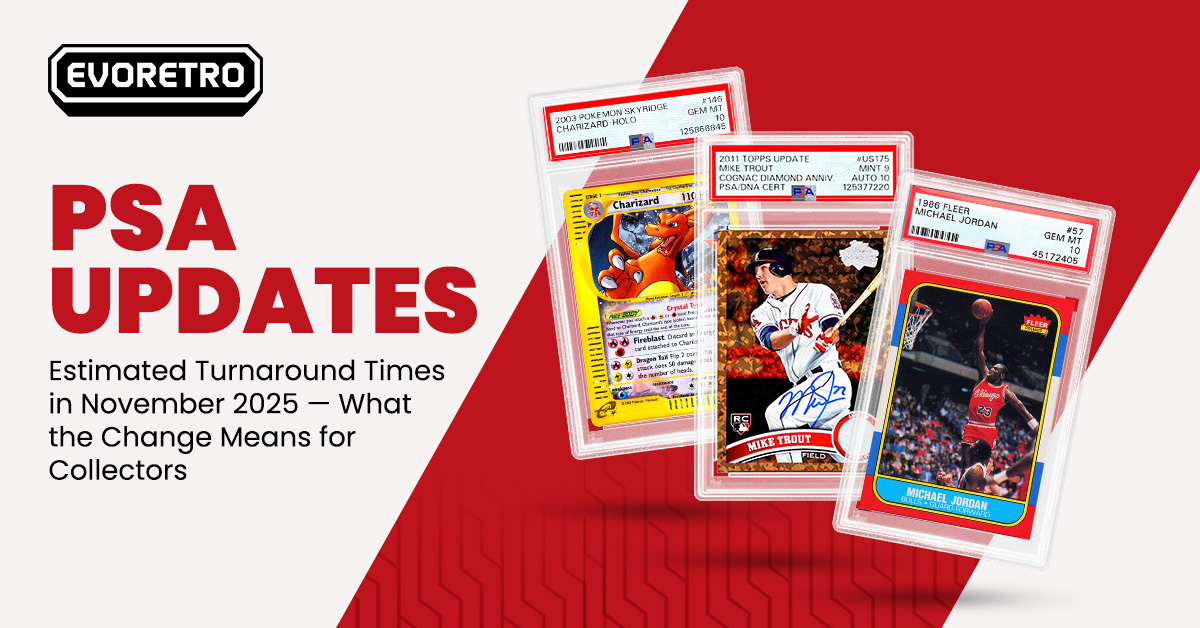
As card grading demand continues to rise across sports cards, Pokémon, and trading card games, PSA has announced an important operational update that directly affects collectors planning submissions in late 2025 and beyond. On November 20, 2025, PSA introduced revised Estimated Turnaround Times (ETAs) across most grading service levels.
While this change may initially appear to extend grading timelines, it is actually designed to provide greater clarity and consistency. For collectors, understanding what has changed — and how to prepare — is key to navigating today’s increasingly active grading environment.
What Changed in PSA’s Estimated Turnaround Times
Historically, PSA’s Estimated Turnaround Times began only after an order was unboxed, verified, and officially entered into their system. Any time spent between delivery and intake was not reflected in the published ETA.
Under the new policy, Estimated Turnaround Times now begin the moment a submission arrives at a PSA facility.
This adjustment means:
- Turnaround estimates may appear longer
- PSA’s grading process itself has not slowed
- Collectors now receive a more realistic timeline from delivery to return
The update applies to all PSA grading services except autograph-only authentication and media items such as DVDs, CDs, Blu-rays, and video games. PSA has indicated this will become the standard approach moving forward.
Why PSA Implemented the Update
The change reflects the continued growth of the hobby and sustained demand for grading services throughout 2025. PSA has processed record submission volumes across multiple categories, prompting major investments in infrastructure and staffing.
Over the past year, PSA has:
- Opened new grading facilities in Boca Raton, Florida, and Plano, Texas
- Announced a European grading center set to open next year
- Expanded its grading team with a rigorous training program, requiring more than 13,000 test-card trials before a grader issues official grades
These efforts are designed to maintain grading quality while scaling operations responsibly. The updated ETA system aligns with PSA’s goal of offering transparency as the grading ecosystem grows larger and more complex.
What This Means for Collectors Submitting Cards
For collectors, the most important takeaway is predictability. The updated ETA model provides clearer expectations when planning submissions for personal collections, resale, or long-term investment strategies.

However, the update also places increased importance on preparation. Since turnaround timing begins upon arrival, the condition in which a card reaches PSA matters more than ever. Any damage that occurs during shipping or intake is now part of the grading timeline and may directly affect outcomes.
As a result, collectors are placing more emphasis on how cards are handled and protected before they are sent in.
How to Prepare Cards for PSA Submissions in a High-Demand Grading Market
With grading demand remaining strong, experienced collectors focus on minimizing risk during the pre-submission phase.
Key preparation steps include:
- Thorough Card Evaluation
Before submitting raw cards, inspect surfaces, corners, edges, and centering under proper lighting. Submitting cards with unnoticed flaws wastes time and grading fees.
2. Correct Sleeving and Holders
Raw cards should always be placed in clean penny sleeves and semi-rigid holders such as Card Savers. Using the right materials reduces movement and friction during transit.
3. Protecting Existing Slabs
Collectors submitting graded cards for crossover or regrading should ensure slabs are protected from scratches, cracks, and impact damage. Slab condition plays a role in presentation and value.
4. Secure Transport and Organization
Large submissions benefit from structured storage. Keeping cards separated, cushioned, and properly packed helps prevent shifting and damage during shipping.
This growing emphasis on preparation has naturally led collectors to seek out higher-quality protection tools designed specifically for grading and transport.
EVORETRO Solutions for Grading Preparation and Card Protection
As collectors adapt to PSA’s updated turnaround process, many turn to EVORETRO for protection products tailored to the grading environment.

Graded Card Bumper Sleeves
EVORETRO bumper sleeves are designed to absorb impact and protect slab edges. Compatible with PSA, Beckett, CGC, and SGC slabs, they help prevent corner chips, cracks, and surface scuffs — especially during shipping or handling.
Perfect-Fit Slab Sleeves
These clear, snug sleeves protect slab surfaces and labels without cloudiness or excess plastic. They are widely used to maintain presentation before submission and while transporting graded cards.
Aluminum Graded Card Cases
For collectors sending multiple slabs or transporting valuable cards, EVORETRO’s aluminum graded cases offer a hard-shell solution with foam inserts and optional locking systems. These cases are built to withstand pressure, movement, and travel-related risks, making them ideal for PSA submissions and long-term storage alike.
Final Thoughts
PSA’s November 2025 update to Estimated Turnaround Times reflects a grading industry that continues to grow and evolve. By starting ETAs at arrival, PSA has provided collectors with a clearer and more accurate view of the grading timeline.
At the same time, this change highlights the importance of preparation. From card evaluation to secure transport, collectors who take proactive steps to protect their submissions are better positioned to navigate today’s grading landscape.
With reliable tools such as EVORETRO’s bumper sleeves, slab sleeves, and aluminum graded cases, collectors can ensure their cards reach PSA safely — and return home in the condition they deserve.